
Wildfires: 5 Areas of Defense
California now appears to have five seasons: winter, spring, summer, fall, and wildfire season. As a result of ongoing drought and other climate-related forces, wildfire season has expanded, starting earlier, and ending later. No community is immune and taking precautions to prepare your home to withstand the threat of wildfire is critical.
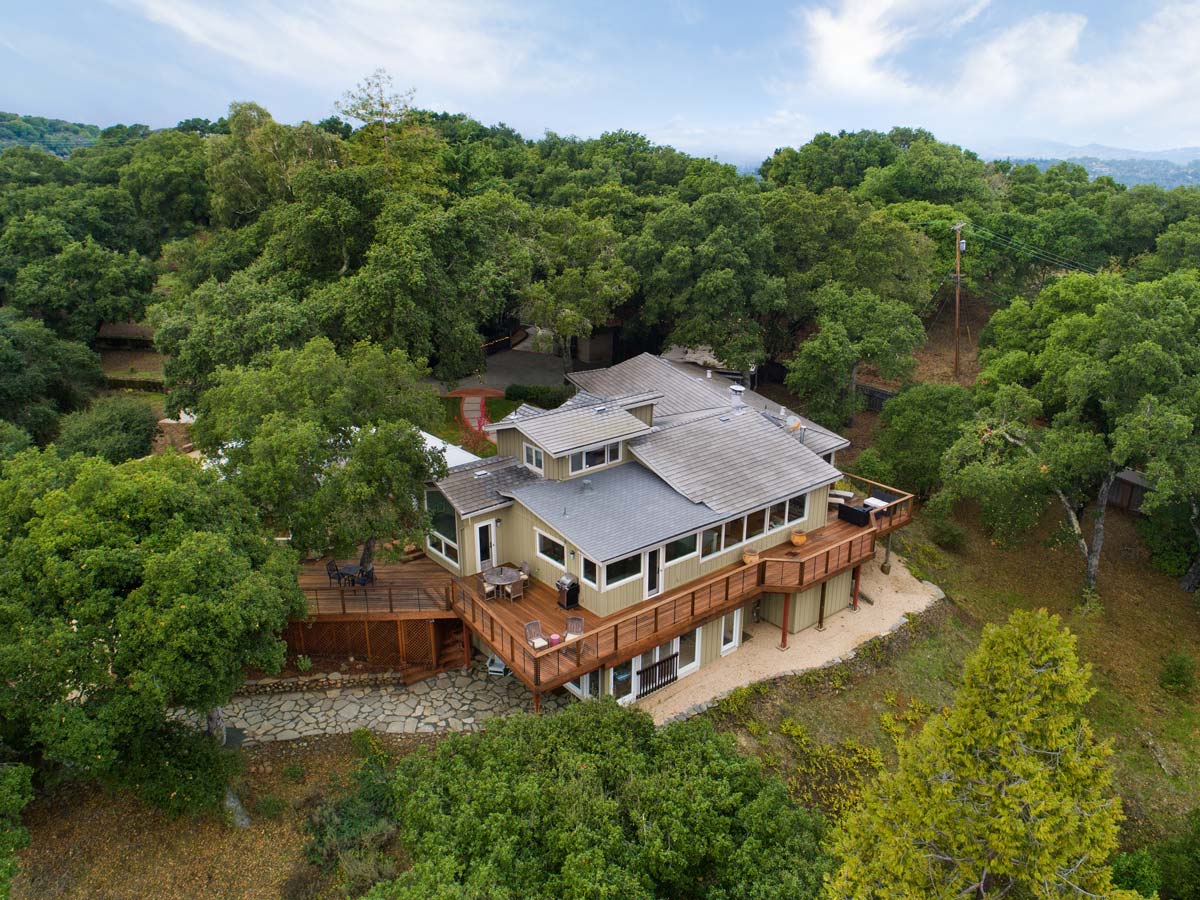
A home with Wildland Urban Interface (WUI)-approved redwood decking
As we enter the 2022 wildfire season, our goal is to provide information on how fire spreads and offer critical insights on increasing the “fire preparedness” of your residence.
We also encourage you to read (or re-read) last year’s article It’s Time to Prepare for Wildfire Season, filled with expert guidelines, checklists, and resources.
How Fire Spreads
Wildfires spread when the flames find new fuel and move outward from the origination point and when embers, small pieces of ignited debris, are blown by the wind to other locations.
An intense wildfire–or numerous wildfires in the same vicinity–can generate its own “microclimate” called a firestorm. A firestorm occurs when heat from one or more wildfires forms a wind system. Even without a firestorm, air currents can carry embers miles away from the ignition source, igniting new fires in surrounding areas.
How Flames Ignite
There are three primary ways homes and other buildings ignite during a wildfire.
- Direct contact with flames
- Embers
- Radiant heat
Embers cause the most residential destruction in wildfire situations. They can land on a building’s exterior and ignite flammable materials or enter through vents, causing a house to burn from within. Embers can also ignite flammable vegetation or materials on or near your home.
Creating Defensible Space
There are steps you can take to protect your home and increase its resilience in the face of wildfire threats.
- Selection, placements, and maintenance of landscaping
- Controlling and/or eliminating combustible materials on your property
- Installing fire and ember-resistant construction materials
According to the University of California Department of Agriculture and Natural Resources, a home’s roof, vents, and vegetation are generally the top priority when it comes to hardening your home. But each situation is unique. Lower priority items, such as siding, eaves, and windows, increase in importance when houses are close together.
Many home hardening improvements don’t have to entail a considerable cost. Removing bark and mulch, leaf litter, low-hanging tree branches, and other combustible vegetation can significantly reduce your home’s vulnerability.
If you are updating or adding new trees, shrubs, and other foliage to your landscaping, choose broadleaf or deciduous trees, which are less flammable than conifers.
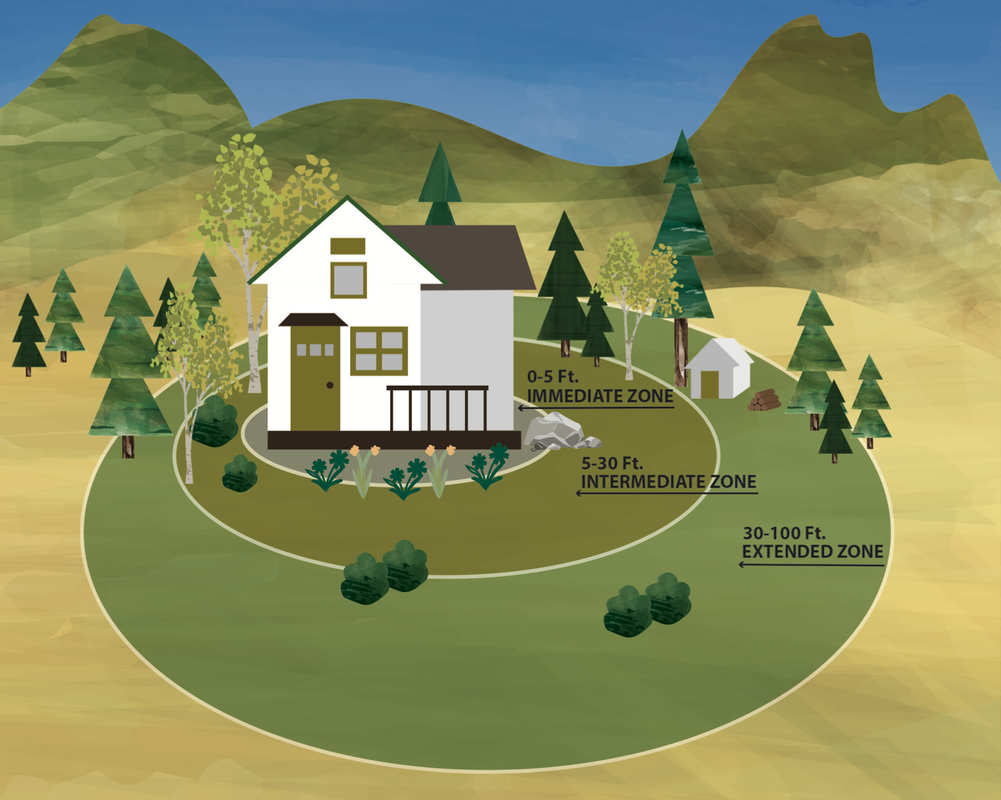
Defensible space (graphic from Wildfire Prepared)
The three primary vegetation zones:
Zone 1: 0 to 5 feet This area closest to your home is the highest priority. Create a five-foot non-combustible area surrounding your home, roof, and under decks by removing or reducing flammable organic debris and materials. Clean out gutters, trim shrubbery, cut back tree branches overhanging your home and keep decks free of debris. Plant low-growing (maximum height of 18”) herbaceous (non-woody) ground covers or succulents in this zone. Within this “close to home zone,” ensure all landscaping is well irrigated and combustible wooden bark and mulch are replaced with a 1.5-inch rock mix or non-flammable mulch.
Zone 2: 5 to 30 feet This area should be groomed to minimize the intensity of a fire and the potential for embers to generate or take hold. Remove vegetation and organic debris beneath trees, trim mature tree branches six to ten feet above the ground, and separate trees from one another and the house. Plants in this zone should be short, high-moisture, and have an open (not dense) structure.
Zone 3: 30 to 100 feet (if applicable) Designed to interrupt the fire’s progress and keep flames on the ground, this zone should be cleared of dead trees, brush, and debris. Thin all living vegetation to create individual “islands” rather than swaths of plants and shrubbery. Keep grass mowed and mature trees pruned 6-10 feet above the ground, with adjacent trees canopies separated.
When preparing each zone, the goal is to work from the inside (the exterior nearest your home) outward. Homes with acreage and those in wildland-urban interface (WUI) zones are more likely to have all three zones, while residences in city or suburban limits may have only one or two. Urban and suburban homes often have overlapping defensible zones, making fire preparedness a neighborhood endeavor.
If a fire is burning within a few miles of your neighborhood, bring outdoor furniture cushions, outdoor rugs, and umbrellas inside. These flammable materials have the potential to ignite if air airborne embers land on them.
For more guidelines about creating fire-resistant landscaping and managing vegetation, click here.
Advice from Our “Fire Wise” Founder
Harrell Design + Build Founder, Iris Harrell, served as Chair of the Firewise USA® Committee for Santa Rosa’s Oakmont Village from 2018 to 2022. Oakmont is a community of 3,200 homes that is no stranger to the devastation of wildfires. Since 2017, its 4,700 residents have endured three separate week-long evacuations. Iris now serves as the Oakmont Board of Directors Liaison to the community’s active Firewise Committee.
Firewise USA is a “program that provides a collaborative framework to help neighbors in a geographic area get organized, find direction, and take action to increase the ignition resistance of their homes and community and reduce wildfire risks at the local level.”
Before moving to Oakmont Village, Iris lived in Portola Valley, located in a wildland-urban interface zone, and has been a Firewise USA® member for more than a decade.
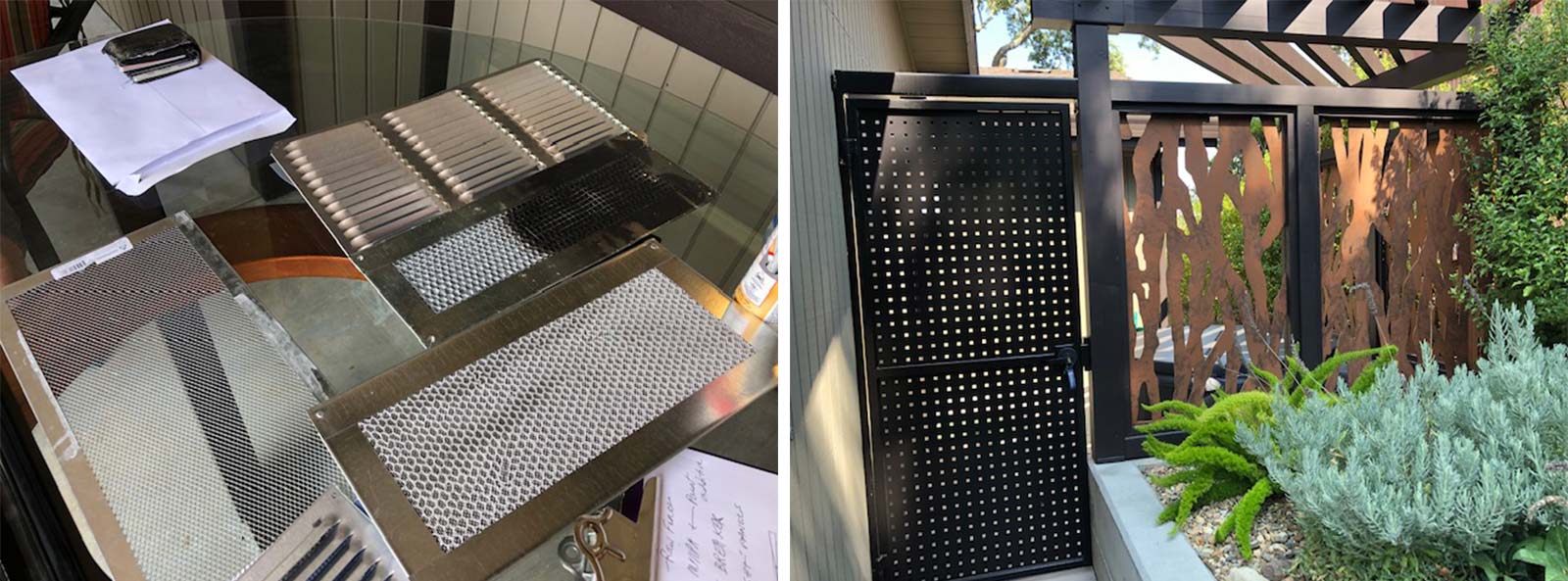
Left: An assortment of foundation vents with appropriately sized screen openings
Right: A fence connected to a house with a metal gate
She suggests these five areas of defense against embers:
- Change foundation, bird’s eye, and attic vents from 1/4″ course screen openings to 1/8″ wire mesh. (1/8” to 1/16” openings are recommended to ensure adequate air circulation in attic and crawl spaces while also keeping them protected against encroaching embers.)
- Replace older roof eyebrow vents with a fire-safe vent such as O’Hagan Fire and Ice vents, or Vulcan vents.
- Closing eave soffits with 1/4″ Hardie concrete soffit plywood with predrilled vent holes.
- Replace the first 5 feet of any wooden fence and gate connecting to the house with non-flammable material, such as metal.
- Add metal guards, commonly referred to as leaf guards, mechanically fastened to the gutters to reduce/minimize debris build-up. Avoid plastic slip-in gutters guards, which can melt and/or blow away.
Iris also notes that ensuring the roof and outdoor deck materials are non-flammable or non-combustible are two additional, albeit more expensive, improvements that reduce a home’s susceptibility to embers.
For over 35 years, the health, safety, and wellbeing of Harrell Design + Build clients, employee-owners, and trade specialists has been a top priority.
If you have questions about how to harden your home, we’re here to help.
Woman Founded and 100% Employee-Owned, Harrell Design + Build has created distinctive homes in Silicon Valley and on the mid-Peninsula since 1985. Our Design + Build Team is here to help you reimagine your home inside and out.